A Bio-Inspired Perspective on Materials Sustainability
New Article Emphasizes Importance of Interdisciplinary Collaboration For Developing a Sustainable and Resilient Materials Economy
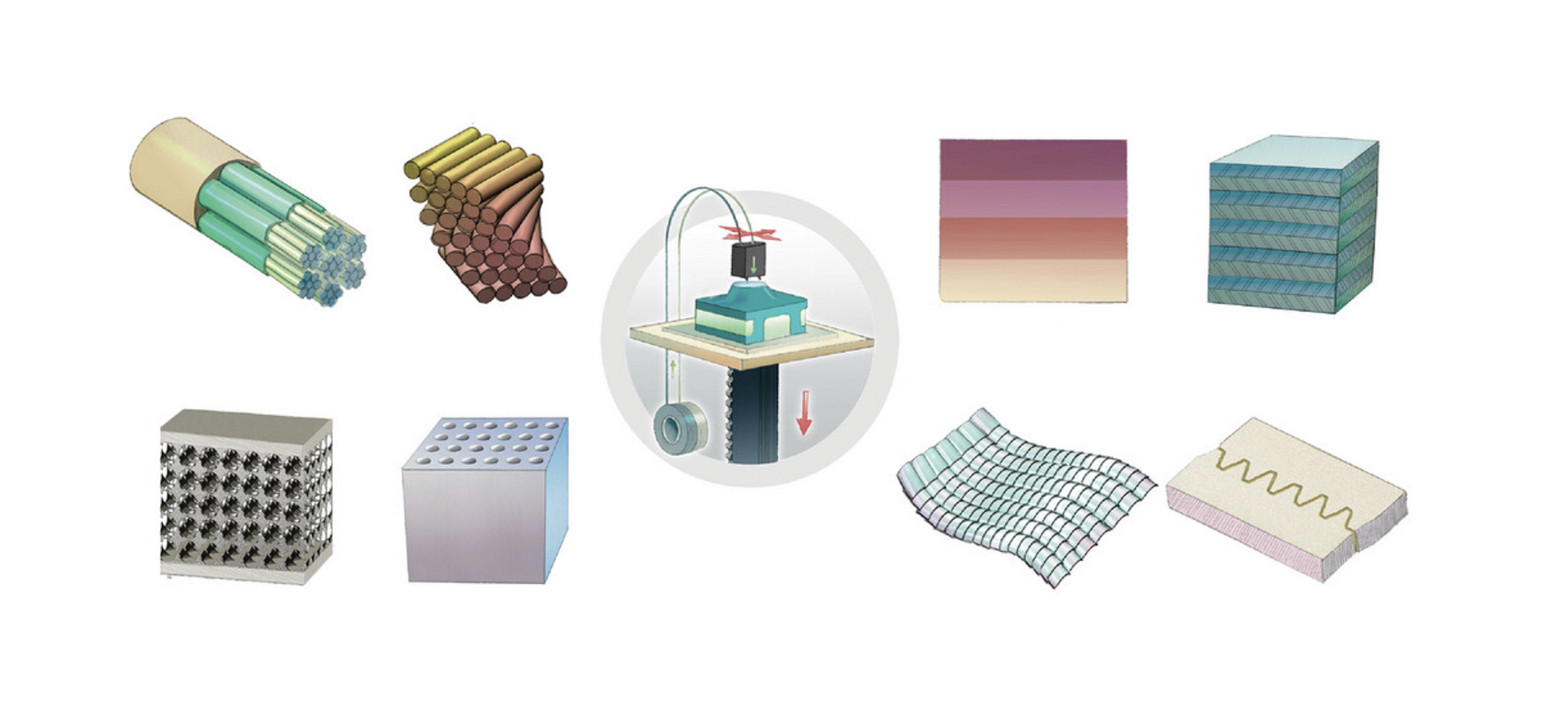
The eight most common biological structural design elements (from upper left to lower right): Fibrous: high tensile strength in one direction, minimal compressive strength; Helical: toughness in multiple directions, in-plane isotropy; Gradient: gradual property transition to reduce interfacial stress, enhancing toughness; Layered: complex composites that improve toughness, especially in brittle materials; Cellular: lightweight porous structures for stress distribution and energy absorption, often in sandwich forms; Tubular: organized porosity for energy absorption and crack deflection; Overlapping: layered plates or scutes for flexible, often armored surfaces. In the center, a 3D printer is shown schematically; Suture: interdigitating interfaces for controlled strength and flexibility (figure inspired by: Naleway et al. 2015). Figure by Konrad Eyferth.
The article by Wolfgang Wagermaier, together with Cluster member Peter Fratzl and Alumni Associate Khashayar Razghandi, explores materials sustainability through a bio-inspired lens and discusses paradigms that can reshape the understanding of material synthesis, processing, and usage. It addresses various technological fields, from structural engineering to healthcare, and emphasizes natural material cycles as a blueprint for efficient recycling and reuse. The study shows that material functionality depends on both chemical composition and structural modifications, which emphasizes the role of material processing. The article identifies strategies such as mono-materiality and multifunctionality and explores how responsivity, adaptivity, modularity, and cellularity can simplify material assembly and disassembly. Bioinspired strategies for reusing materials, defect tolerance, maintenance, remodeling, and healing may extend product lifespans. The principles of circularity, longevity, and parsimony are reconsidered in the context of ›active materiality‹, a dynamic bio-inspired paradigm. This concept expands the traditional focus of material science from structure-function relationships to include the development of materials capable of responding or adapting to external stimuli. Concrete examples demonstrate how bio-inspired strategies are being applied in engineering and
technology to enhance the sustainability of materials. The article concludes by emphasizing interdisciplinary collaboration as a key factor for developing a sustainable and resilient materials economy in harmony with nature’s material cycles.
For the full-text version of the text, see https://doi.org/10.1002/adma.202413096.