Intercultural Views on Images, Space and Material
Matters of Activity in Tokyo
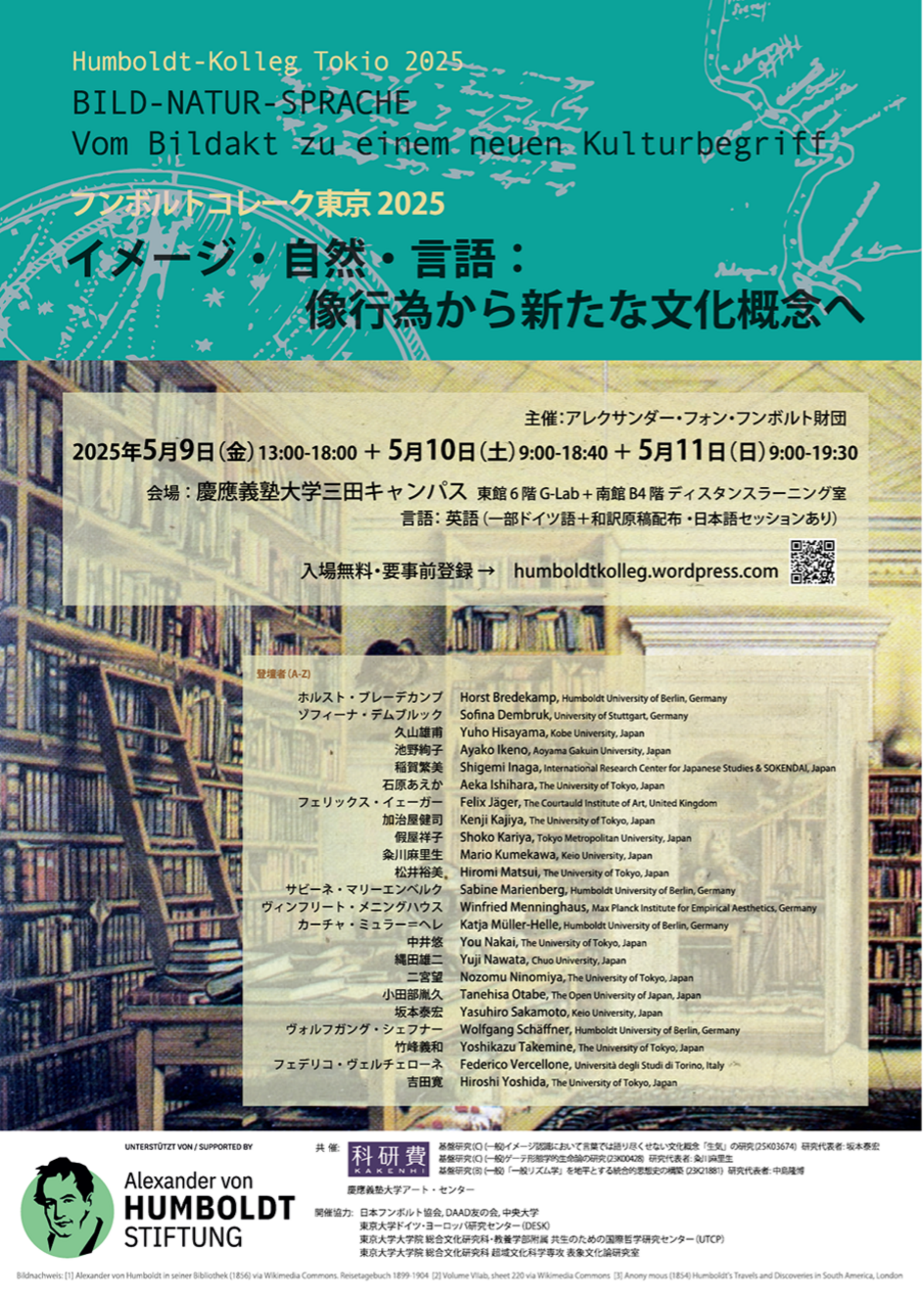
Humboldt Kolleg 2025, »Bild – Natur – Sprache: Vom Bildakt zu einem neuen Kulturbegriff«
The Humboldt Kolleg 2025, organized by the image scientist Yasuhiro Sakamoto with the support of the Humboldt Foundation at Keio University in Tokyo, was an extraordinary event. Under the German title of »Bild – Natur – Sprache: Vom Bildakt zu einem neuen Kulturbegriff« Yasuhiro Sakamoto (Keio University) brought together an impressive community of Japanese researchers, for whom German is even more fluently spoken Western language than English. Even if there is a long tradition of important German-Japanese cultural and scientific exchange, in recent years Europe seems smoothly fading away in Japan’s intercultural panorama, a process which also becomes evident in the diminishing number of German Studies students. While in late 20th Century Europe was still a guiding cultural attractor, today the exchange with the neighboring Asian countries such as Korea, Vietnam, Singapore, Taiwan, and China is taking the lead.
Having this fundamental change in mind, the Humboldt Kolleg 2025 focused on image acts, cultural techniques, material humanities, and empirical aesthetics as challenging new German perspectives for the Humanities and for a move toward a new concept of culture. Within this context, »Matters of Activity« was represented by Horst Bredekamp, Sabine Marienberg, and Wolfgang Schäffner, accompanied, amongst others, by Katja Müller-Helle, representing the Zentrum für Kulturtechnik of HU, and Winfried Menninghaus, the founder of the MPI for Empirical Aesthetics (Frankfurt).
Thus, thinking about a new role of the humanities was articulated primarily through the complementary approaches of empirical aesthetics, as established by Winfried Menninghaus at the MPI in Frankfurt, and the theoretical backbones of »Matters of Activity«, such as the Theory of the Image Act of Horst Bredekamp which was a guiding line of the conference, Friedrich Kittler’s media theory, and the material humanities as part of an integrative materials research presented by Sabine Marienberg and Wolfgang Schäffner together with the literary scholar Yuji Nawata. What a radical experimentalization of aesthetic questions with its close connection between the humanities and natural sciences means on the one hand, and what the intensive collaboration between the humanities and material sciences with the design disciplines of »Matters of Activity« articulates on the other, was guiding our reflecting the contemporary challenge of the humanities within intercultural perspectives. Within this German context, the Japanese researchers presented fascinating historical and cultural analyses of exemplary European constellations in art, literature and philosophy and the respective impact in Japanese thinking, e.g. in the aesthetic theory of Masakazu Nakai as presented by Tanehisa Otabe (Open University of Japan), or by Hiromi Matsui (University of Tokyo) on the calligraphic characteristics in André Masson and Chi-Yun-Sheng-Tung, or by Yuji Nawata who presented a woodblock of Eduard Mörike as a creative collaboration between matter, non-human actors and the poet in the session »From Cultural Techniques to Natural Techniques«. The whole three-day event was framed not only by Yasuhiro Sakamoto’s exemplary overview of Bildwissenschaft from Antiquity to AI and his special gift of creating an overwhelming atmosphere of friendship, but also by intense encounters with exemplary cultural spaces of Tokyo, such as the archive of Tatsumi Hijikata’s archive of Butoh dance at Keio University.
An optimistic perspective on the future of the humanities and Japanese German Studies was quite programmatically present already at the beginning of the Humboldt Kolleg through the impressive presentation of ten doctoral projects by young Japanese researchers that demonstrated their highly productive intercultural view on German and European Literature, Art, and theory. The three-day event also triggered an initiative of several participating researchers from the humanities, materials science, and architecture for developing a Tokyo-based interdisciplinary research group in the spirit of »Matters of Activity«. These are indeed indications of a real opportunity for a new culture of exchange between Europe and Asia, which has perhaps never been as necessary as it is today.
Wolfgang Schäffner
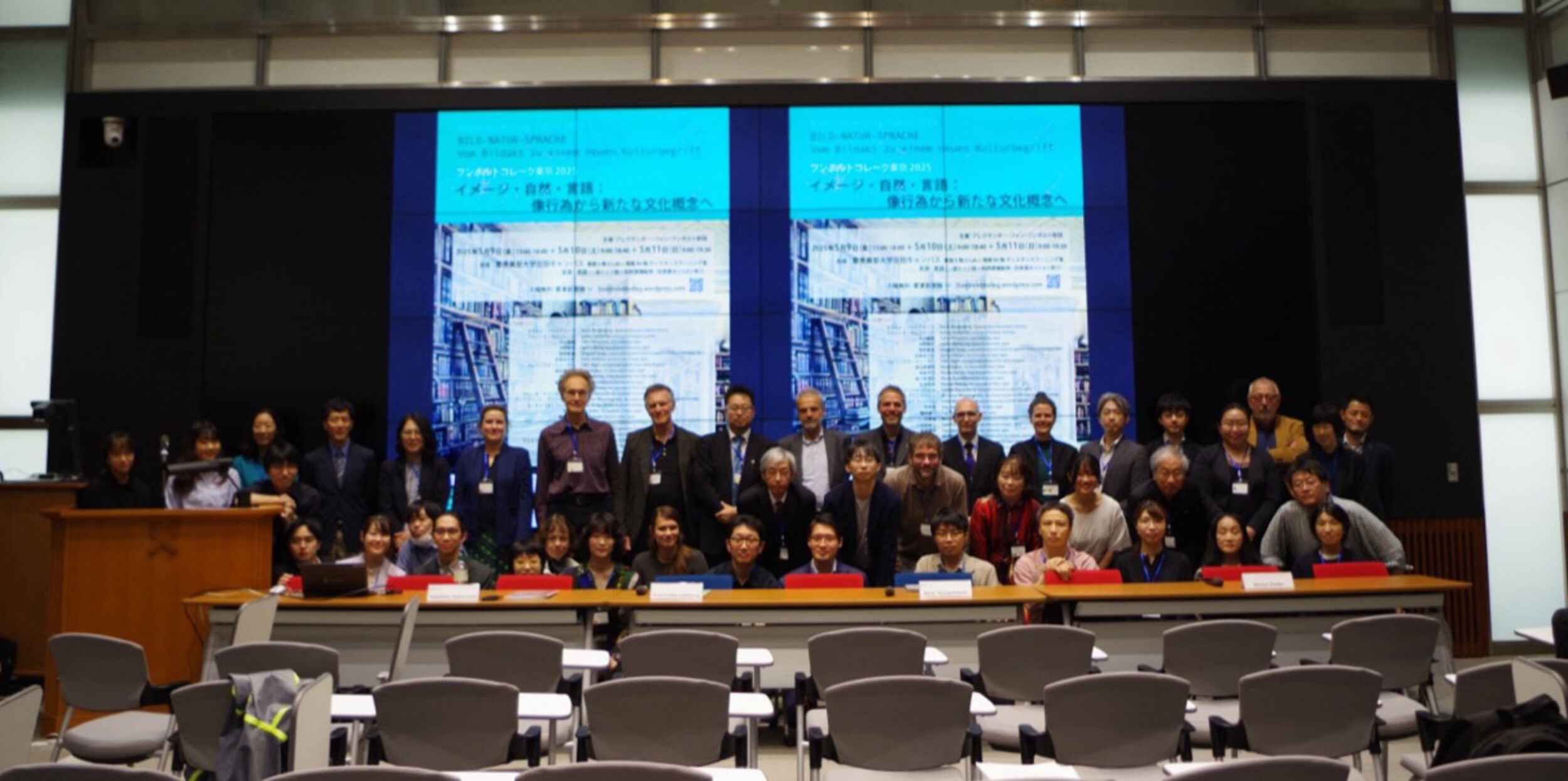
Wolfgang Schäffner, Sabine Marienberg & Horst Bredekamp in Tokyo, May 2025