
Understanding the Fiber Architecture of the Brain's White Matter
New Approach Promises More Precise Diagnosis and Treatment Planning for Rare Brain Disorders
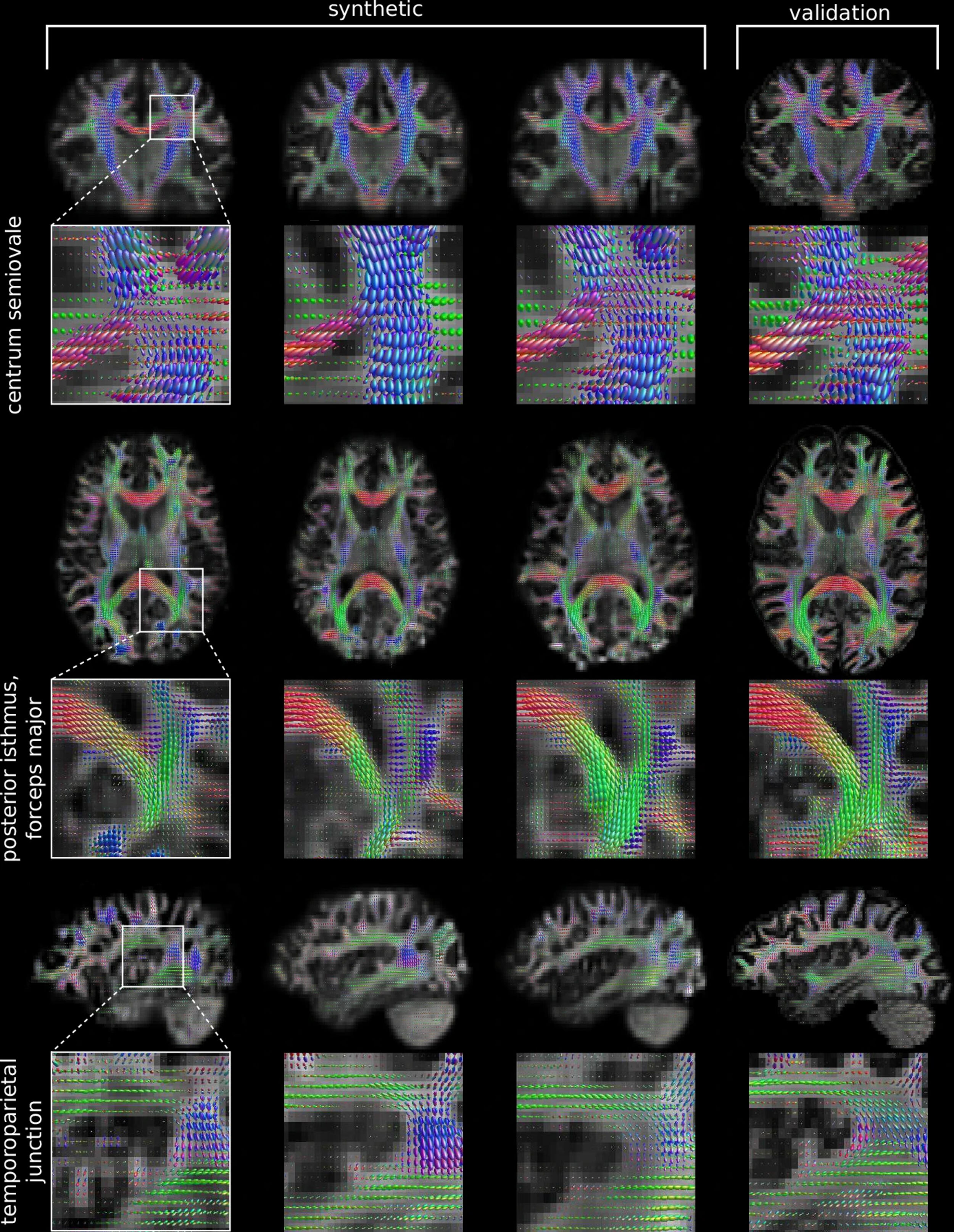
The figure shows fiber orientation distribution (FOD) data artificially generated using generative adversarial networks (GAN) compared to a validation dataset. Fig. 1 in: Vellmer, S., Aydogan, D.B., Roine, T. et al. Diffusion MRI GAN synthesizing fibre orientation distribution data using generative adversarial networks. Commun Biol 8, 512 (2025). https://doi.org/10.1038/s42003-025-07936-w.
The recently published article »Diffusion MRI GAN synthesizing fibre orientation distribution data using generative adversarial networks« addresses a common problem in medical research: the lack of sufficient training data, especially for rare conditions. The authors, including Cluster Members Lucius S. Fekonja and Thomas Picht, developed an innovative approach using generative adversarial networks (GANs), a machine learning framework, to create realistic synthetic fiber orientation distribution (FOD) data from diffusion MRI. FODs represent the directional diffusion patterns of water molecules in brain tissue, providing crucial information about the underlying fiber architecture. By training their machine learning model with high-quality brain scan data from the Human Connectome Project, the interdisciplinary team demonstrated that these synthetic FODs can successfully reproduce complex microstructural properties of the brain's white matter. It shows that this approach could significantly enhance research on rare brain disorders by providing additional training data for machine learning algorithms, ultimately supporting more accurate diagnosis and treatment planning.
The article was published in Communications Biology: https://doi.org/10.1038/s42003-025-07936-w